










|
|
|
|
|
A
sequence and number of rulers of this Dynasty is pretty well established. Some
doubts arise in case of queen Merytneith who
lived in time of Djet and Den. Some scholars identify her with the pharaoh
Merneith. Unfortunately, for lack of any serekh with his name the identification
remains suspect. The length of reign of Dynasty I kings is hardly to establish
because of lack of any reliable evidence save the very questionable
transcriptions from Manetho and fragmentary
records on the Palermo Stone.
Until now the scholars are not thoroughly unanimous as to the burial place of
the I dynasty pharaohs. Already Manetho favored the opinion that cemetery of
rulers of that period was at Abydos in Upper Egypt, or more precisely:
Umm el-Qaab necropolis located nearby. In
years 1938-58, at Memphite necropolis, north Sakkara, had been discovered
a cemetery dated back to the I dynasty period. Number and size of mastabas
discovered at Sakkara suggest that was a burial place of the kings of the
unified land while tombs at Abydos are merely cenotaphs (empty tombs). At
Sakkara, around almost all royal tombs (excluding Aha and Semerkhet), there are
numerous tombs of higher court nobles. Both theories have as much
followers as opponents, however in light of recent analysis and excavations of
the German expedition at Umm el-Qaab necropolis, it can be assumed that kings of
the archaic period were buried just in the Umm el-Quaab necropolis in Upper
Egypt. |
||


|
|
|
|
The Bull’s Palette, now in the Museum of Louvre, descends presumably from Abydos. Commemorates either defeat of Beduins from desert or, as others suggest, capture of some cities of Upper Egypt (Asyut, Koptos, Hermopolis, Panopolis). Banners may have symbolized allied cities under the ruler named Bull. The palette has been dated to period either of Narmer’s rule or immediately before him. Height 27,5 cm. | |


|
3080-3040 |
Narmer
( Menes )
|

| (Horus Name) |
 |
Hr nar |
 |
Hr nar-mr |
|
 |
Hr nar-mrw |
|
 |
Hr nr-mr TA |
|
 |
Hr nr-mr TAw (Horus Striking Catfish) |
|
| Abydos
Table (Nomen) |
 |
mni |
| Turin
Canon (Nomen) |
 |
|
|
|
 |
 |
|
Macehead of Narmer. Draw. Ashmolean Museum Oxford. |
Macehead of Narmer |

|
|
|
3040-3020 |
Aha
|
| (Horus Name) |
|
Hr aHA |
| Abydos
Table (Nomen) |
 |
tti |
| Turin
Canon (Nomen) |
|
it[i] |


The
ruler usually identified with Menes (Narmer) and as such regarded as a first
king and founder of the Dynasty I. His name is well known from numerous
relics discovered at Abydos and Saqqara. Events taking place during the rule
of Hor Aha are known to us mainly from four annual plates. He made wars
against Ethiopians and Libyans. He came from the Upper Egypt and married
princess
Neithotep
from the Lower Egypt. At Sais in the Delta he erected a temple dedicated to
Neith. According to W. Helck one of the plates records killing a human for
sacrifice. In
Manetho’s
opinion the king was a practising medical who was writing treatises on
anatomy. Although his chief wife was Neithotep, The king’s wife was
Neithotep, his son and successor was – Djer – was born from a concubine.
Names of other Andjib’s sons are known to us: Rechit, Het, Saiset, Imaib. To
the time of king’s Hor Aha rule are dated two big sepulclar complexes at
Naqada and Saqqara. A monumental mastaba, measuring 53 x 26 m at Nakada
possibly belonged to the king or his wife. The tomb S3357 at Saqqara,
previously ascribed to Aha, resembles a mastaba of 41,6 x 15,55 m and 5 m
high. Most likely he was buried in
the three-chambered
tomb B10-B15-B19
in the Umm el-Qaab necropolis at Abydos. |
|
 |
 |
| Tablet of Aha. Top row to the right: Horus Name and Nebti Name of king Aha with a sign interpreted as Men in a booth like structure | Faience vessel
fragment with serekh of Hor Aha. British Museum |
|
3020-2970 |
Djer
|

| (Horus Name) |
|
Hr Dr |
| Abydos
Table (Nomen) |
|
iti |


In light of recent evidence he must have ruled longer than Manetho ascribed to him (31-39 years), possibly up to 50 years. In W. Helck opinion the analysis of eighteen annual inscriptions in Stone of Palermo indicate that Djer ruled at least 54 years. The ruler put much attention to consolidate political unification of Egypt. In his 23 years of rule he presumably conquered the land of Sekhat (most likely Sinai and south Palestine). Inscription with the name of Djer was found at Wadfi Halfa, south to the First Cataract, but its authenticity is questioned by archeologists. Three annual plates mention some political events: investing at Buto and Dep, importing wood of Lebanon, re-unifying of the land, death of two queens, building of a palace and others. His tomb at Abydos (tomb O) in the Umm el-Qaab necropolis had been later regarded as burial place of Osiris and became a cult centre and destination of pilgrimages, especially in times of the New Kingdom and onwards. Two big niche-shaped mastabas S3471 and QS2185 at Sakkara and possibly also S3503 mastaba ascribed to queen Merytneith, belong to this king. Djer might have been son of the previous ruler by one of his wives named Chenedhapi. Djer’s wife was queen Herneith. |
|
 |
 |
| Four bracelets were found on a bandaged
arm in the tomb of king Djer at Umm el-Qaab in 1901. Lapis lazuli, turquoise, ametyst, gold |
Stela of
king Djer from Abydos. Egyptian Museum |
|
2970-2960 |
Djet ( Wadji )
|
| (Horus Name) |
|
Hr Dt |
| Abydos
Table (Nomen) |
 |
itA , itiw |
| Turin
Canon (Nomen) |
|
itAi , itiwi |


|
An
interpretation of this king’s Horus-name is very questionable.
Manetho mentioned a famine in Egypt under this king’s reign and
erection of a pyramid called Kochome. The Nebti-title of this king is
Iterti and it refers to the unification of the Egypt. In time of Djet
and his heir Den, a very mysterious character was living - Merneith
(male form) or
Merytneith
(female form) known because of a tomb at Abydos. According to one hypothesis Merytneith was a
daughter of Djer and a wife of Den. Thus she would be a regent in first
period of Den’s reign. Burial place – tomb Z in
the Umm el-Qaab necropolis
nearby Abydos.
|
|
 |
 |
|
Fragment of an object bearing the serekh of Djet and the name of a court official Sekhem-Ka-Sedj. Egyptian Museum, Cairo |
Stele of Djet from Abydos. Louvre Museum |
|
|
Merytneith ( Merneith )
|
| (female form) |
 |
mrt-nit |
| (male form) |
 |
mr-nit |
|
The queen held rule probably as regent before her son and heir, Den, grew up. She was wife of Djet and daughter of Djer and queen Herneith. Her name appears on artifacts both in male form - Merneith and female - Mer-[y]t-Neith. Her tomb at the Umm el-Quaab necropolis in Abydos is surrounded by numerous burials of her servants. Also two stelae of Merytneith come from Abydos. On these stelae her name is not inscribed in serekh and there is no Horus falcon, the facts both point at the fact that she was indeed a woman. |
|
 |
Queen Merytneith stele from
Umm el-Qaab (Abydos). Cairo Museum. The crossed arrows are the emblem of the goddess Neith, part of the queens's name. |
|
|
|
|
2960-2915 |
Den ( Udimu )
|
| (Horus Name) |
 |
Hr dn |
| (Nebti Name) |
 |
nb.ti xAs.ti |
| Turin
Canon (Nomen) |
 |
sm.ti |
| (Nomen) |
 |
sm.ti |
| Abydos
Table (Nomen) |
 |
sp.ti |
|
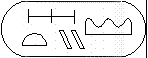
According
to Manetho’s records Usafais (Den) ruled 20 years, however other sources
assume longer, possibly 35-40 (Godron) or even 45 (Kaplony) regnal
period of this pharaoh. From all records we find out that Den made
numerous expeditions against Asiatic people and nomads of Sinai. His
Nebti name was inscribed with a double sign of mountains. This
hieroglyphic group can be interpreted as Chasti or Semti. A cursive form
of the sign of mountains is very similar to another hieroglyph,
interpreted as Septi. Three tombs at Sakkara are assigned to Den: 3035
(the bigger royal tomb dated to predynastic period), 3036 (presumably
tomb of a queen) and 3506. He was buried in
tomb T in the Umm el-Qaab necropolis at Abydos.
|

|
|
|
Famous tablet of British Museum represents King Den
smiting an Asiatic. This “relic” is probably a case of modern forgery. The king
is wearing nemes with uraeus, common attributes of royalty appearing much later
in ancient Egypt history. |
Ebony label EA 32650 from Den's tomb. The upper right register depicts king Den twice: at the left he is sitting in his hebsed pavilion, at the right he is running a symbolic race around D-shaped markings. The middle right section reports about the raid of the city "beautiful door" and about a daughter of Den suffering from an unknown disease. |

|
2915-2905 |
Andjib
|
| (Horus Name) |
 |
Hr anD-ib |
| (Nebti Name) |
 |
nb.ti mr-p-biA |
|
Saqqara Table (Nomen) |
 |
mr-bA-pn |
| Turin
Canon (Nomen) |
 |
mr-biA-pn |
| Abydos
Table (Nomen) |
 |
mri-biA-p(w) |
|
Meribiapen is the first king whose name is recorded on the table of Saqqara, while it is not present on the Palermo Stone at all. Turin Canon assigned 74 years (of rule?). Manetho argues 26 years to Miebis. In actual fact he must have not ruled more than 10-12 years although he celebrated his Heb-Sed at least once. The S3038 tomb at Sakkara, located north from royal tombs and having a flat feature of step pyramid is dated back to Andjib times. Andjib’s tomb in Abydos (tomb X) at Um El-Qaab necropolis is small and relatively poor. One of his wives was Betrest, mother of his follower, Semerkhet, commonly regarded as usurper. |
 |
|
Stone vessel fragment bearing Andjib serekh |
|
2905-2890 |
Semerkhet
|
| (Horus Name) |
 |
Hr smr-X.t |
| (Nebti Name) |
 |
Nebti [iri] ? ...
|
 |
Nebti ... (Nebti Name write in cartouche) | |
| Turin
Canon (Nomen) |
 |
smsm |
|
Abydos Table (Nomen) |
 |
Semsw (?) |
|
Turin Canon of Kings
gives 72 years (of rule?) to him while in
Manetho’s opinion this king reigned 18 years. He might have been a
son of queen Betrest – king’s Adjib wife, and of unknown father. His
heir to the throne was Qa’a who considered him as an usurper.
|
 |
 |
|
Alabaster vase of Semerkhet. |
Pottery sherd inscribed with Semerkhet's serekh, from his tomb. Petrie Museum, UC36756 |
|
2890-2860 |
Qa`a
|
| (Horus Name) |
 |
Hr qA-a |
| (Nebti Name) |
 |
nb.ti qA-a |
 |
sn nb.ti (?) |
|
 |
sn nb.ti (?) |
|
| Abydos
Table (Nomen) |
 |
qbH |
|
Saqqara Table (Nomen) |
 |
qbHw |
| Turin
Canon (Nomen) |
 |
qbH |
|
Turin
Canon gives 63 years of rule, while Manetho – 26 years. Period of his rule might have been longer (33-34
years), as indicated by data on annual tables. Two celebrations of his
Sed festival are known to us. Stone of
Palermo is damaged at that place and only short note of his coming
to the rule and first year of rule are readable. Possibly he held his
predecessor Semerkhet as usurper because he ordered to destroy his names
while the name of his own father, Anedjib, left untouched (J. von
Beckerath). N. Grimal’s point of view Qa’a was father of Semerkhet. Tomb
of Qa’a is located at Abydos (tomb Q)
and had been greatly extended. Mortuary complex at Saqqara is the first
in Egyptian history which includes mortuary temple, which became the
indispensable part of sacral complex of each ruler ever since. |
 |
 |
|
|
Tablet from Umm el-Qaab, Abydos. |
Restored stele of Qa'a. Museum of Archeology and Antropology, University of Pensylvania |
Tablet from Umm el-Qaab , Abydos. |


|
|
Copyright © 2000-2023 Dariusz Sitek, Czestochowa - Chicago - Ann Arbor |
|
|
|